

Our President and COO Mike Dixon didn’t get to pick his squad while serving in the U.S. Army.
You don’t interview for culture fit in the military. You get whoever the Army assigns you. That meant people who grew up on farms serving in the same unit as people who grew up in the city, immigrants, wealthy kids, different ranks, different technical specialties, and sometimes people loaned to you from another unit for a single mission and gone the next week.
Mike talked about the lessons this taught him as a guest on the Owner’s Diary podcast with Sanjar Shadiev: “One of the most beautiful things about the U.S. Army was it brings together people from all walks of life. You know, folks who grew up in the country, folks who grew up in the city, immigrants, wealthy kids. All these different people from all these different backgrounds thrown together… Learning how to quickly pull people together from all these different backgrounds and experiences to achieve a common goal. Immediate applicability to the entrepreneurial space.”
Mike carries that lesson directly into how he leads at Hoops. Assuming culture fit means chemistry, hiring people who already think and act alike, isn’t just impractical. It actually works against you. Bringing in people from different backgrounds is a real strength, and not something to filter out. The goal was never getting everyone to think and look the same. It’s getting everyone aligned on the same standard, language, and stakes.
Culture Fit Isn’t About Chemistry or Sameness
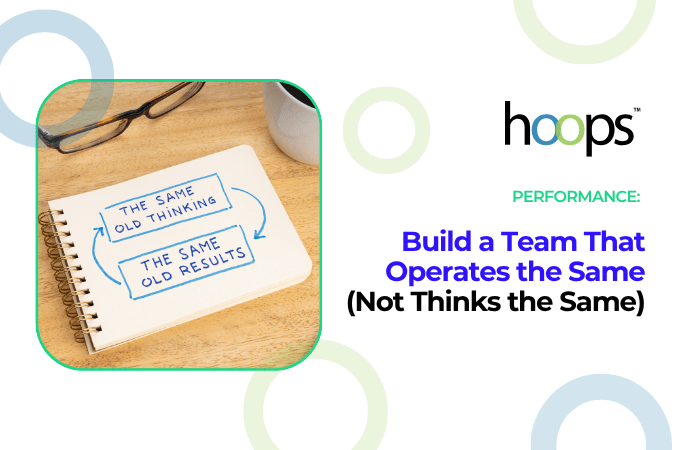
Mike recently posted on LinkedIn that he used to think “culture fit” was about chemistry, and he was wrong. What he’s learned since: “You don’t need a team that thinks the same. You need a team that operates the same.”
That’s a different idea than culture fit. Culture fit usually means finding people who already feel like they belong, similar backgrounds, similar instincts, similar thinking, and people who’d naturally get along in a room (the “beer test”). We’ve written before about why that’s a risky filter in our blog on hiring for culture add over culture fit, mostly because it quietly screens out people who’d actually make the team better precisely because they think differently.
There’s a real cost to getting this wrong, too. A team that “clicks” too easily can turn into a team that stops challenging each other. When everyone agrees too fast and nobody pushes back to consider a better way, the results can be enormous. Coca-Cola’s infamous 1985 “New Coke” launch is a textbook example. CEO Roberto Goizueta made the call with a small committee of five executives and a PR consultant, a tight, agreeable group that’s since been studied specifically for how it dismissed clear warning signs from its own market research in favor of the numbers that confirmed what they already wanted to believe. The backlash was immediate and massive, and the product was pulled from shelves in under three months. Groupthink kills growth and can be costly, both hard to catch until it’s too late.
Mike’s Army squad is proof that real alignment doesn’t require sameness at all. Zero shared background, zero natural chemistry, and it still worked, because operating the same way never required thinking the same way. He names three specific things that make it work: the Standard, the Language, and the Stakes.
The Standard
Don’t ask for “quality.” Everyone will give you a point-of-view answer that doesn’t align. It’s too vague and subjective. Instead, define exactly what “good” and “great” look like, so there’s no room left for interpretation.
This isn’t just a nice idea, it’s one of the most heavily researched findings in workplace performance. Gallup has spent decades studying what actually predicts whether a team performs, surveying millions of employees across every industry. Out of everything they’ve tested, “I know what is expected of me at work” ranks as the single strongest predictor, ahead of pay, ahead of recognition, ahead of nearly everything else companies spend money trying to fix.
Most leaders assume their team already has this. The issue is, they usually don’t. Picture a sales team where leadership just says “we want strong performance.” One rep hears that as 50-plus cold calls a day. Another hears it as a 20% or better close rate. A third hears it as building long-term client relationships, aiming for 80%-plus retention, even if that means fewer closes this quarter. Without a clear standard, nobody here is wrong. All three could arguably count as “strong performance.” Then leadership finds out the hard way at review time, forced to let go of someone who’s genuinely blindsided, because they thought they’d been meeting expectations the whole time. Use SMART goals when defining KPIs: make the standard specific, measurable, achievable, relevant, and give it a deadline.
The Language
Likewise, don’t ask for “speed” or “urgency” and assume everyone in the room means the same thing by it. The word “love” in English versus Greek versus Spanish has completely different definitions when you actually look it up, and gets used and implied in different ways depending on the language. Language is subjective, and everyone on a team needs to be speaking the same one.
McKinsey’s Organizational Health Index, built on more than 20 years of research and over 2 million survey responses, found that healthy, well-aligned organizations are three times more likely to outperform unhealthy ones. Part of what separates the two isn’t the strategy itself, it’s whether the language behind it is specific, actionable, and understandable across levels and functions. Our point? A brilliant strategy explained in vague terms produces the same results as no strategy at all.
Here’s another hypothetical, but realistic, scenario we see play out all the time. A client asks for something “urgent.” To the account manager, that means today. To the ops team fulfilling it, urgent means it’s next in the queue after what’s already committed, maybe by this Monday. Again, no one got this wrong. The team just never agreed on what “urgent” means depending on who’s saying it, a client, an executive, or a teammate. They never actually agreed on what the word meant, and the client experiences that gap as a broken promise, one that can get expensive fast.
The Stakes
Lastly, don’t just hand out goals with the intention of “do this because it’s your job” or “because I say so.” Make sure every person actually knows the company and personal consequences if the team doesn’t hit them. And on the flip side, and most importantly, create personal incentives that genuinely motivate people to hit those outcomes, not just the vague sense that they’re helping the company (or the CEO) get richer. Our blog on retaining people after you’ve hired them gets into real ways to structure incentives so your team shares in the win, not just carries the risk of the loss. Help them see clearly why, how, and where they’re valuable.
There’s a real term for this in HR research: line of sight, an employee’s understanding of how their specific work connects to the organization’s actual outcomes. Research on this goes back over two decades, and the finding holds up consistently: employees who can clearly see that connection perform better and stay longer than employees who are just handed a number to hit. Most employees can’t describe how their role actually positively affects the company and its revenue. That’s not usually because they don’t care, but because nobody’s ever walked them through it.
Here’s a last example: a team can hit 90% of a target and still have no real sense of whether that mattered. Did missing that 10% cost a renewal? Push a hiring plan back a quarter? Put someone’s bonus at risk? What’s actually at stake, for the company and for the person, if they win or lose? If nobody’s ever connected those dots out loud, the number is just a number, and motivation doesn’t show up out of nowhere.
First Steps To Building an Aligned, Diverse Team
Naming three pillars is a great first step, but it doesn’t make it a reality yet. Consultant Patrick Lencioni, whose work on organizational health has shaped how a lot of well-run companies operate, describes the real work as four disciplines: build a cohesive leadership team, create clarity, overcommunicate clarity, and reinforce clarity. Notice that three of the four are about repetition, not a one-time announcement.
Start with the Standard. Pick one role or one team and write down the actual definition of “good” for it, specific enough that two different managers would score the same person’s work the same way. If they wouldn’t, it isn’t written well yet, and it’s still just a feeling everyone assumes they share.
Do the same audit for language. Pick the two or three words your team uses constantly (words like “urgent,” “quality,” “done”) and ask three different people what each one actually means in a specific scenario. If you get three different answers, you’ve still got inconsistent language on your hands.
Finally, apply the same rigor to the stakes. Walk each person through their own specific connection: what does hitting or missing this target actually mean for the business, and what does it mean for them personally? Most leaders explain this once, when someone starts or at a kickoff, and assume it stuck. It didn’t. Roles shift, priorities change, and a connection that felt obvious in January can feel abstract again by June if nobody’s reinforced it since. Revisit it as often as you revisit the Standard and the Language, not less. Create a shared team goal, with personalized incentives tied to it, to make it work.
Build and Scale a Team that Exceeds the Bar
Mike didn’t get to choose who stood next to him. Yet he still got a diverse room full of strangers moving in the same direction, fast, with no time to build chemistry first. Most businesses have it easier than the high stakes the military faces consistently, and still get it wrong, because they’re waiting for something to feel right instead of building the thing that actually makes it work.
You don’t need your team to think alike. You need them to know exactly what good looks like, exactly what your words mean, and exactly what’s on the line. Build that, and the rest tends to follow.
Need help hiring and scaling a team that continues to meet, and exceed, the standard? That’s what Hoops specializes in, so you don’t have to get it wrong first.
👉 Schedule a free discovery call to learn more
Build Your Winning Team. Hire and Scale Talent.