

Five years ago, the average job posting attracted around 100 applications. A big pile, sure, but manageable for most hiring teams handling lower-volume searches. According to Greenhouse data, today that number is 242 applications per job posting — and that’s the new baseline, not an outlier!
That’s more than double the volume in five years, and the reason isn’t that the job market suddenly got more competitive. It’s that candidates figured out AI before most employers did.
The Greenhouse 2025 AI in Hiring Report found that 74% of U.S. job seekers now use AI in their application process, and 49% say they’re submitting more applications than they were just a year ago specifically to get past automated filters. Greenhouse CEO Daniel Chait has a name for what this has created: an “AI doom loop.” Candidates use AI to apply to more jobs, so employers use AI candidate screening to filter more aggressively, so candidates use even more AI to get through — and the cycle keeps escalating on both sides.
Mike Dixon, President and COO of Hoops, calls it exactly what it is. “There’s the AI arms race that keeps going back and forth between employers and candidates,” he said on the AI Growth Blueprint podcast. And if your hiring process hasn’t caught up with that reality yet, it’s worth asking whether it’s actually working as well as you think it is.
And the Volume Is Only Climbing
Here’s something every recruiter and hiring manager can probably relate to. The New York Times reported on an HR consultant who received over 1,200 applications for a single remote role. She was so overwhelmed that she pulled the listing entirely and spent three months manually sorting through submissions just to make sense of what she had.
Now, 1,200 applicants is obviously on the extreme end. But the dynamic she experienced isn’t. When that kind of volume hits a process that was built for a different era — post a job, wait for applications, open resumes one by one, schedule some calls, make a decision — the whole thing breaks down fast. It’s not an effective use of your team’s time or brainpower. It drives burnout. It costs more in hours than most companies realize. And by the time someone finally gets to a strong candidate, that person has often already moved on to a company that got there faster.
And honestly, volume alone isn’t even the whole problem. A meaningful portion of those applications are now AI-optimized to say exactly what your job description asked for, regardless of whether the candidate can actually do the job. So you’re not just dealing with more applications — you’re dealing with more applications that are harder to evaluate on face value alone.
What’s Actually Happening on the Candidate Side
It helps to understand what candidates are actually doing, because it directly shapes what employers need to do differently.
GenAI tools like ChatGPT, Gemini, Claude, and Grok have made it genuinely easy for any job seeker to build a polished resume, tailor it to a specific job description, and submit an application in a fraction of the time it used to take. On top of that, the barrier to applying has dropped dramatically (thanks to things like Indeed’s “One-Click Apply” pushes), which is a big part of why volume has gone up the way it has.
And the resumes look good. That’s the other piece of this. A candidate who isn’t particularly qualified can now produce an application that reads like they are, because AI is very good at packaging experience in the language employers respond to.
That said, this isn’t a reason to disqualify candidates for using AI. Mike is clear on this point. “We’re never going to disqualify somebody using AI,” he said on the AI Growth Blueprint podcast. The goal isn’t to catch people using AI tools (in fact, adaptability and creative thinking are what you want in a hire). The goal is to find the person who can actually do the job, and those are two very different problems. Conflating them leads to a process that ends up filtering for resume quality instead of actual fit, which doesn’t help anyone.
Where Most Hiring Processes Fall Short
The volume problem doesn’t create new weaknesses so much as it exposes the ones that were already there. Here’s where we see it most:
- The job description isn’t doing its job. A vague, aspirational, or outdated job description doesn’t just attract the wrong candidates — it makes AI matching worse. When your requirements aren’t specific, AI screening tools can’t surface the right people, and candidates can optimize their resumes to hit keywords that don’t actually reflect what you need. “Does the job description of what you’re hiring for accurately reflect your expectations of what that person is going to do?” Mike said on The Business Blueprint. “It continues to amaze me how many folks don’t do that.”
- There’s no filter between the application and the hiring manager. When volume doubles and the process doesn’t change, the people doing the hiring absorb the extra work. That means slower decisions, more inconsistent reviews, and the very real possibility that strong candidates get lost in the pile because nobody had time to get to them.
- The process moves too slowly. Good candidates are evaluating multiple opportunities at once. A process that takes six weeks to get to a first conversation is a process that loses people — not always to a better offer, but often just to a company that moved faster.
- Human time is going to the wrong places. A lot of companies are spending human time on things AI could handle (reviewing every resume manually, managing interview scheduling back and forth) and not enough time on the moments that actually require judgment (assessing fit, reading someone in a conversation, or understanding what’s really motivating a candidate to make a move).
What the Winning Companies Are Doing Differently
The companies navigating this well aren’t the ones who’ve automated everything, and they’re not the ones still doing it all by hand. They’re the ones who’ve been thoughtful about which parts of the process benefit from AI, like AI candidate screening, and which parts still need a real person.
Mike describes it as using AI to genuinely accelerate the process, not just layer it on top of everything and hope for the best. “We don’t want to just spread AI peanut butter across an organization and declare victory,” he said on the AI Growth Blueprint. “We’ve got to lead with empathy. Here are concrete use cases on how we can apply AI to make your life better.”
For example, this looks like:
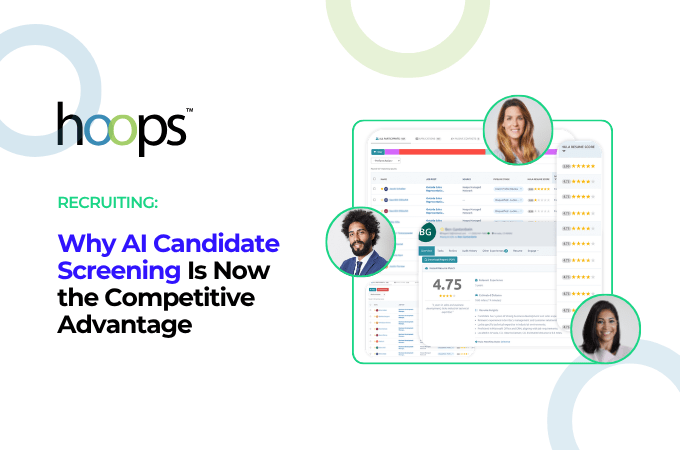
- AI takes on the front-end volume. Resume screening, candidate scoring, job ad placement and optimization, scheduling, follow-up communications and similar busy work — all of this can run on AI without losing anything important in the process. At Hoops, we use Hula AI Resume Matching to score every applicant on a 1-to-5 scale based on how well their experience aligns with the actual job description. Hiring managers see the strongest candidates first, with a plain-language summary of their strengths and potential gaps. No more opening 200 resumes hoping to find someone worth a call!
- Market data informs the search before it starts. One of the most underused applications of AI in hiring is what happens before a job ever gets posted. Before you write the job description, you should know what the role is actually paying in your market, how difficult it is to fill based on current supply and demand, and whether your requirements are realistic given the available talent pool. Matching your opportunity against these realities is crucial to accelerating the hiring process. That information used to take weeks to pull together and was often stale by the time it was ready. But now AI market reports make it available in real time (at a fraction of the cost, too), which changes a lot of decisions downstream.
- Real people stay in the moments that matter. AI can surface the right candidates (and a whole bunch of incredible stuff). But it cannot assess cultural fit, read between the lines of a conversation, catch the red flags that don’t show up on paper, or understand what actually motivates someone to make a move. “We recommend you talk to these people first,” Mike explained on the AI Growth Blueprint, describing how Hoops uses AI screening to bring the most qualified candidates to a hiring manager’s calendar. “And maybe we even screen some of them for you and bring the best qualified to your calendar for a live meet.” The human element should never go away, but now is freed up thanks to AI to show up in the moments that matter.
A Note on Jobs That AI Can’t (Nor Should) Replace
There’s been a lot of noise about AI replacing jobs, and it’s worth addressing briefly because it shapes how employers are thinking about all of this.
The fear that AI would eliminate jobs wholesale hasn’t played out the way most people predicted. Radiology is a good example — it was widely expected to be one of the first fields displaced with the AI boom, and it wasn’t. “We actually have greater demand,” Mike said on the AI Growth Blueprint. “We’ve changed the role of radiologists. The human capital wasn’t cut out of the process. In some ways, it [AI] amplified it.”
The same thing is happening in hiring. AI isn’t replacing recruiters and hiring managers. It’s changing what they spend their time on. The companies excelling right now are the ones using AI to get the volume work off their team’s plate so their people can focus on the judgment calls that actually determine whether a hire sticks.
Welders, HVAC technicians, nurses, teachers, etc. — AI isn’t replacing those roles either. And the companies that hire in those spaces still need to run a process that’s fast enough and human enough to attract the right people. The tools are different, but the principle is the same: use AI where it creates leverage, and keep humans where they create value.
So Where Do You Start?
If your hiring process hasn’t been updated since before AI became part of the candidate toolkit, here’s where to start:
1. Fix the job description first. Before you post anything, make sure it accurately reflects what this person will actually be doing, what success looks like in the first 90 days, and what the real requirements are (not a wish list). We recommend clearly marking what’s a must-have (requirements) vs. nice-to-have (preferred skills/qualifications). A strong job description makes everything else work better including AI screening, candidate matching, interview conversations, and onboarding expectations. Our past blog here gives more practical tips to put together a killer job description (and yes, you should use AI to perfect it!)
2. Get market data before you set compensation. If you’re guessing on salary or working from what you paid the last person in the role, there’s a good chance you’re already uncompetitive. Real-time market data tells you what the role is worth right now, in your specific market, for the skills you actually need.
3. Add a filter between the application and your calendar. Whether that’s AI candidate screening and resume scoring, a short application question that requires a real answer, a brief phone screen, or some combination (which is best!) — there needs to be a filter between “applied” and “interview” that isn’t a hiring manager manually reviewing every submission.
4. Move faster once you find someone good. The best candidates are not waiting around. If your process has three rounds of interviews, two weeks between each one, and a two-week offer process after that, you are losing people — not to better offers necessarily, but to faster-moving companies.
5. Keep humans in the key conversations. Use AI to get to the right candidates faster. Then invest real time in the conversations that let you assess whether this person is the right fit for your team, your culture, and the specific challenges the role involves. That’s where good hiring decisions actually get made.
AI Candidate Screening Is the New Playing Field
Build Your Winning Team. Hire and Scale Talent.