

Artificial intelligence (AI) has made its way into almost every corner of hiring. That includes resume screening, job postings, interview scheduling, candidate outreach, and the list keeps growing. And honestly, a lot of it is genuinely useful.
But there’s a version of this story being told right now that isn’t quite right. The idea that if you just add enough AI to your hiring process, the hard parts go away. That you can automate your way to great hires.
That’s not how it works.
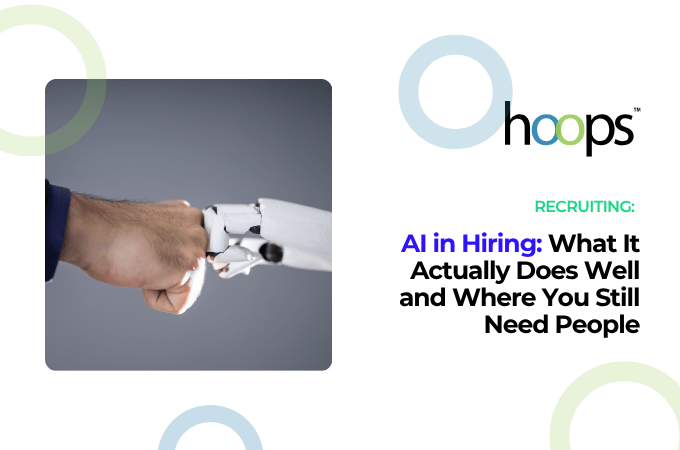
The teams seeing real results aren’t the ones who’ve replaced people with AI. They’re the ones who’ve figured out where AI creates leverage and where human judgment is still irreplaceable — and built a process that uses both intentionally.
That’s a distinction worth exploring deeper.
Why AI in Hiring Has Become Impossible to Ignore
It’s no secret that hiring has gotten harder. There are more applicants (including AI-generated ones — yikes), more competition, higher expectations from candidates, and less bandwidth for the people managing it all. Leaders are already stretched thin running their businesses, and adding a full recruiting operation on top of that is a lot to ask.
AI addresses a very real problem: volume. The ability to process large amounts of information quickly, surface patterns, and make data-driven decisions at a speed no human can match. That’s insanely valuable, and a big reason why adoption is accelerating across companies of every size.
But the reason to use AI in hiring isn’t novelty. It’s efficiency, and specifically, the kind of efficiency that frees up your team to focus on the decisions that actually require people.
Where AI in Hiring Actually Delivers Efficiency
1. Resume screening and candidate matching
This is the clearest win, and the one with the most immediate impact.
Reviewing resumes manually is slow, inconsistent, and often unfair — even with the best intentions. AI can scan hundreds of applications in seconds, score each candidate against your job description, and surface the ones worth your time first.
At Hoops, Hula AI does exactly this. Every applicant gets a 1-to-5 star score based on how well their experience and skills align with the role. You can see at a glance how many years of relevant experience someone has, how far they live from the job, whether there are any notable gaps — and a plain-language summary of their strengths and where they fall short. No more opening 200 resumes hoping to find something. The best candidates rise to the top automatically.
And when your requirements change mid-search — which happens all the time — you can bulk rescore your entire applicant pool in seconds. That kind of flexibility used to be impossible.
2. Smarter job advertising
Most companies post a job, pick a couple of boards, set a budget, and hope for the best. That approach is expensive and increasingly ineffective.
Programmatic advertising flips the model. Instead of manually deciding where your job should appear, AI places it across various job boards simultaneously and automatically shifts your budget toward the sources producing better applicants. The system learns as it goes — tracking which boards are sending qualified candidates and optimizing accordingly.
The result is lower cost per application and higher quality candidates. Not because you spent more, but because you stopped wasting money on placements that weren’t working.
3. Reducing bias in early-stage screening
Unconscious bias in hiring is real, and it’s one of those things that’s easy to acknowledge in the abstract and hard to actually fix in practice. When humans review resumes, factors that have nothing to do with job performance like names, schools, formatting, and employment gaps, can biasly influence decisions.
AI removes most of those human bias variables. It evaluates qualifications, experience, and fit against the job description, and nothing else. That creates a more consistent, objective starting point for every candidate, which matters both for the quality of your hiring decisions and for building a workforce that actually reflects the talent available to you.
4. Market intelligence before you even post
One of the most underused applications of AI in hiring is what happens before a job goes live.
AI-powered market reports can tell you what similar roles are paying in your market, how difficult a particular position is to fill based on supply and demand, what competitors are offering, and how realistic your requirements are given the available talent pool. That’s information that used to take weeks to pull together and was often outdated by the time it was ready.
Hoops’ Market Insights reports put that data at your fingertips before the search starts — so you’re not guessing on salary, setting unrealistic expectations, or posting a job that’s already uncompetitive.
5. Workflow automation that gets time back
The back-and-forth, ankle-biter work of coordinating and scheduling phone screens, following up on application questions, or checking in on progress is all necessary to move through the hiring process, but it is extremely time-consuming.
AI-powered workflows can handle most of this automatically, including sending interview invitations, reminders, and updates without anyone having to manage the back-and-forth manually. It’s genuinely one of the biggest efficiency gains in recruiting. And for candidates, a process that moves smoothly and communicates clearly is a direct reflection of your company.
Where AI in Hiring Falls Short
1. AI doesn’t understand your business and culture
It can match a resume to a job description with impressive accuracy. It cannot understand your culture, your leadership dynamics, what success in this role actually looks like eighteen months from now, or why the last three people who had this job didn’t work out. Did you know that 89% of hiring failures are due to a lack of poor culture fit/poor attitude, and not a lack of skills (Forbes)? This is where a real person is needed to apply real human judgment.
2. It’s only as good as what you feed it
Garbage in, garbage out, and that applies here too. If your job description is vague, the matching will be inconsistent. If your requirements list is a wish list rather than a real set of criteria, you’ll filter out strong candidates who could have grown into the role. AI doesn’t fix bad hiring strategy — it moves faster with it, which can actually make things worse. Working with a recruiting team that can establish a strong foundational strategy and confirm an accurate job description is beyond critical.
3. The candidate experience can degrade fast
Candidates are increasingly frustrated by hiring processes that feel completely automated — no feedback, no human contact, no sense that anyone actually looked at their application. And that frustration has real consequences for your employer brand. The best candidates have options. A cold, robotic process is a reason to go somewhere else, and you may never know that’s why they left.
4. Candidate decisions still require people
AI can rank candidates. It cannot read between the lines of a conversation, catch the red flags that don’t show up on paper, recognize potential that a resume undersells, or understand what actually motivates someone to make a move. Those judgments require experience and intuition, and they’re different for every team and every company. No AI algorithm can ever do that.
How to Make AI in Hiring Work Well
The teams getting the most out of AI in hiring right now are the ones who’ve been deliberate about where AI helps and where people still need to lead. Here’s how to think about it practically:
- Start with your biggest bottlenecks. Where are you losing the most time? Where are decisions getting made slowly or inconsistently? Start there, since that’s where AI creates the most leverage. Do not try to automate everything at once.
- Invest in your job description. AI matching is only as good as what you feed it. If your job description is vague or has a laundry list of “must-haves” that aren’t actually deal-breakers, the AI is going to give you messy results and over-eliminate strong potentials. Take the time to get specific about what you actually need and what is optional.
- Keep humans at the decision points. Use AI to filter and prioritize, but not to establish rapport (interviews) or to make final decisions. The candidates that come through should still be evaluated by a real person who can assess fit, culture, and the things a resume can never tell you.
- Don’t let automation replace communication. Candidates should always be able to reach a real person if they need to. Timely updates, clear expectations, and a process that treats people like people — that reflects on your company even when someone doesn’t get the offer.
- Track the data and keep improving. One of the best things AI does is generate information you can actually learn from. Data like cost per application, source quality, and time to hire by role. Use it to continuously refine the process.
In practice, it looks like this: AI handles job ad placement and optimization so your posting reaches the right candidates without manual guesswork. Applicants get scored and ranked automatically, so your team spends time on the best fits, not the whole pile. Scheduling and follow-ups run without anyone having to manage the calendar. And then, at the moments that actually matter, real people step in.
At Hoops, that’s the whole model. Hula AI, programmatic advertising, market insights, and workflow automation all run in the background to make the process faster and smarter. But real, U.S.-based recruiters are the ones evaluating fit, adjusting strategy, running phone screens, and guiding clients through offer decisions. Some clients use AI phone screening as an efficient first filter. Others go straight to a live recruiter. Many use a combination of both depending on the role. The point isn’t to pick one or the other — it’s to use each where it actually adds value.
AI in Hiring: In a Nutshell
Build Your Winning Team. Hire and Scale Talent.