

Remember the “Great Resignation”? Of course you do. A few years ago, it felt like everyone was quitting to chase a better title or a bigger paycheck.
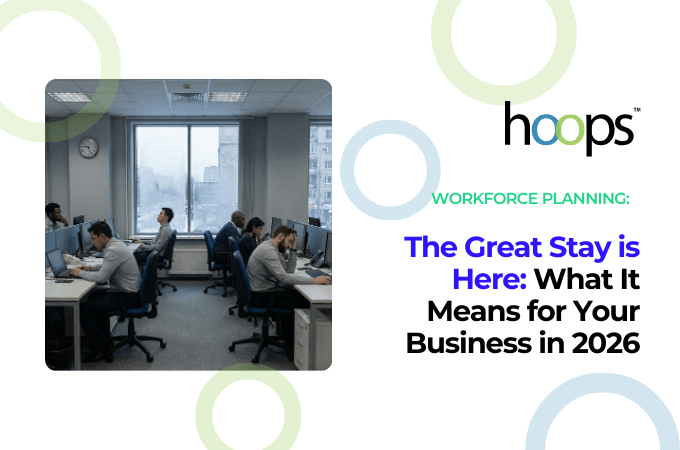
Well, flip that coin over. Welcome to The Great Stay.
In 2025, the script flipped. Workers stopped jumping ship. Now, heading deeper into 2026, they are staying put.
For a business owner, this sounds like a dream, right? No more scrambling to fill empty seats! But here is the hard truth: Retention does not equal engagement, and top candidates are even harder to win over.
Let’s look at the real data, the hidden risks, and exactly what you need to do to turn this trend into your competitive advantage.
What is “The Great Stay”?
Simply put, workers are holding onto their jobs.
A few years ago, people quit because they felt confident they could find something better. Today, the vibe has changed. Voluntary quit rates have dropped to about 2%, which is the lowest we’ve seen in a decade.
Why? It’s not necessarily because everyone is super happy. It’s often because they are worried.
- The “Big Freeze”: Companies aren’t just slowing down hiring; many are actively cutting back. A recent study found that 56% of business owners expect to make headcount cuts in the next year.
-
The Perception of Scarcity: With headlines about layoffs and budget cuts, employees have the impression that there are fewer safe harbors out there.
Employees are hunkering down because they think they have fewer places to go.
3 Sneaky Traps You Might Miss
1. The Engagement Trap: “Quiet Cracking”
When people stay out of fear, they become “stuck.” They stop trying to impress you. And worse: they get bored and experience burnout.
This leads to a phenomenon experts call “Quiet Cracking.” It’s a consistent feeling of unhappiness that tanks performance, but because of the economy, the employee feels too trapped to quit.
Why should you care? Because it is very expensive.
A study in the American Journal of Preventive Medicine estimates that burnout costs companies between $4,000 and $21,000 per employee annually due to lost productivity. For a mid-sized company, that could mean millions in lost value every year.
And the scary part? You probably don’t even see it happening.
Check out this massive disconnect from 2025 data:
-
79% of employees said they felt burnt out at work.
-
But only 40% of business owners noticed it.
That means 39% of business owners don’t even realize it’s happening. Your team might be physically present, but mentally checked out.
2. The Skills Trap
Remember: if you aren’t hiring new people, you aren’t bringing in new skills.
When you have low turnover, your “idea pool” can get stagnant. You stop getting those fresh perspectives that new hires bring.
-
A 2026 trends report found that 48% of HR leaders say they are dealing with a “skills gap” right now.
-
This means your current team might not have the skills you need for the future (like AI or advanced tech), but you aren’t hiring new talent to fix it.
3. The “Easy Hiring” Trap
This is the most dangerous assumption of 2026. You might think, “Since no one is hiring, it must be easy for me to find great people!”
Wrong. It is actually harder.
Because the market feels risky, fewer people are willing to move. The pool of “active” candidates is much smaller. To get a great employee to leave their current “safe” job, you can’t just offer a slightly better salary and benefits. You have to offer safety.
Data for 2026 shows that job security is now the #2 priority for candidates, right behind pay.
Candidates are terrified of being “last in, first out” in this uncertain market. If you want to hire the best, you need to show them that you are a safe bet.
Your 2026 Game Plan: Stop “Filling Seats” and Start “Designing Teams”
The “Great Stay” doesn’t have to mean “The Great Stagnation.” You can win this, and here is what informed business owners are doing differently this year.
1. Sell Stability, Not Just Salary
When you are recruiting, don’t just talk about the paycheck. Talk about your history.
-
Show your receipts: “We haven’t had a layoff in 5 years.” “We have $X in cash reserves.” “We grew by X% last year.”
-
Differentiate with safety: In a fearful market, boredom is less scary than risk. Prove that you are a stable home for their career and worth the move.
2. Shop in Your Own Closet (Internal Mobility)
If your employees are bored, don’t wait for them to quit. Move them!
-
LinkedIn’s 2025 Report found that 55% of top-performing companies have made internal mobility (moving people to new roles) a top priority.
- LinkedIn’s 2026 Report found that companies can grow their talent pipeline by 8.2x just by focusing on internal mobility.
-
It is cheaper than hiring, keeps institutional knowledge in the building, and re-energizes your best people.
3. Bridge the Empathy Gap
Remember that burnout stat? 79% vs 40%? Don’t assume your team is fine just because they are quiet.
-
Talk to your team and ask specific questions about their workload.
- Consider moving them into a new role or helping them take on “fresh” new projects (a win-win for everyone, solving both burnout and skills gaps in one go).
-
A little empathy and small adjustments go a long way to turning a “prisoner” (someone staying out of fear) into a “partner” (someone staying because they love it).
4. Build What You Can’t Buy (Upskilling)
Here is the reality: Since you aren’t hiring as many new people, you aren’t importing new ideas. You have to build them yourself.
-
The “Self-Inflicted” Gap: That 48% skills gap mentioned earlier? Leaders admit it’s often “self-inflicted” because they didn’t train their people fast enough.
-
The Fix: Training isn’t a “perk” anymore; it is your supply chain for talent. Identify the 1-3 mission-critical skills your business is missing and upskill a current employee to master it. And it’s another win-win where you get the skill while they get the growth.
- Don’t Forget “Human Skills”: According to LinkedIn, 91% of leaders say “human skills” (like leadership and communication) are more important than ever. If you can’t hire a new manager, train your best player to become one.
Need a Co-Pilot for The Great Stay?
While the rules of recruiting have changed amid The Great Stay, the good news is you don’t have to figure it out alone!
At Hoops HR, we help small and mid-sized businesses find the right talent and build the strategies to keep them. We go beyond standard HR and recruiting to become your true people strategy partners. From hiring to personalized leadership development and custom engagement tools, we provide the end-to-end solutions you need to navigate this new era of work.
Whether you need to find a needle-in-a-haystack hire or figure out how to wake up your current team, we’ve got your back.
Let’s Talk Strategy – Contact Hoops HR Today
Build Your Winning Team. Hire and Scale Talent.